CAPruner: Conceptual-Adjacent Scene Graph Pruner for Enhancing 3D Spatial Reasoning of Large Language Models

Shengli Zhou1 Xiangchen Wang1 Guanhua Chen1 ✉️ Feng Zheng1 ✉️
1Southern University of Science and Technology

Overview

Large language models (LLMs) have recently been applied to 3D vision-language (3D-VL) tasks, which require spatial reasoning to identify target objects relative to anchors. Scene graphs are commonly employed to represent such relations, but reasoning over complete graphs incurs high token costs and computational inefficiencies, motivating the need for pruning. Existing pruning methods primarily rely on spatial proximity and often remove task-relevant relations, thereby undermining reliable spatial reasoning.

To address these limitations, we derive a key requirement for scene graph pruning: preserving spatial relations that are most pertinent to the specific 3D-VL task. Guided by this insight, we propose the Conceptual-Adjacent Scene Graph Pruner (CAPruner). CAPruner integrates fuzzy semantic relevance with spatial proximity to estimate the importance of relations, enabling the selection of critical relations in a task-specific context.

Moreover, to avoid costly relation-level annotations, CAPruner is trained by supervising the aggregated scores of each node's incident edges. Extensive experiments demonstrate that CAPruner effectively preserves relations essential for spatial reasoning, leading to substantial performance improvements of LLMs on 3D-VL tasks.

Method Overview

Core Idea

Estimate the importance of spatial relations and choose a set of relations with O(n) size that contains all key spatial relations that are used for spatial reasoning.
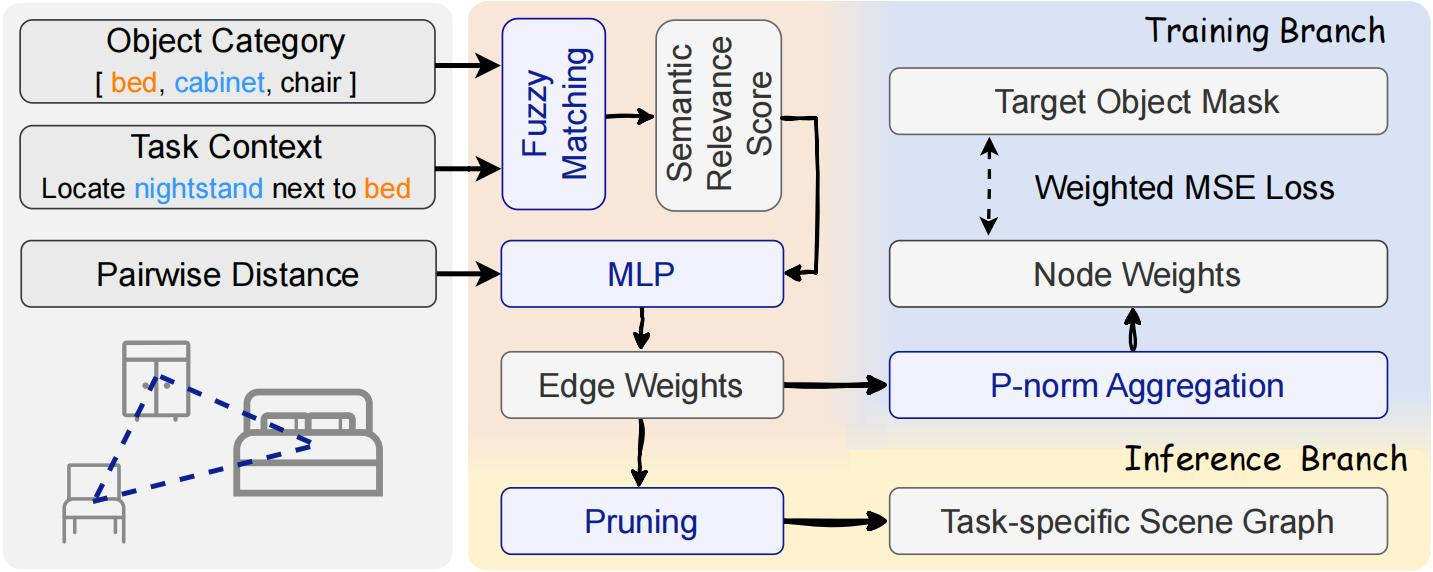
CAPruner

Figure 1: The model architecture of CAPruner.

CAPruner

  • Estimates object-query semantic relevance via fuzzy matching on object categories.
  • Combines semantic cues with geometric spatial proximity to predict edge weights.
  • Adaptively prioritizes query-relevant spatial relations.
  • Achieves high token efficiency (34% reduction in token usage).

Node-wise Supervision

  • Employs p-norm aggregation to aggregate edge weights into node weights.
  • Supervises node weights using only available target object labels, avoiding costly relation-level annotations.
  • Utilizes a Weighted MSE loss to balance the contributions of target and non-target objects.

Experimental Results

We compare CAPruner with strong 3D LLM baselines across 3D VG (ScanRefer) and 3D VQA (ScanQA, SQA3D) benchmarks. All results show consistent and substantial gains from CAPruner compared to the proximity-based KNN pruning strategy (3DGraphLLM).

Main Benchmark Results

Model ScanRefer A.@0.25 ScanRefer A.@0.5 ScanQA B-4 SQA3D EM@1
3DGraphLLM-1B 52.5 47.5 12.2 52.6
CAPruner + Llama-3.2-1B 55.0 49.6 13.0 52.8
3DGraphLLM-8B 60.2 54.6 12.5 55.2
CAPruner + Llama-3-8B 61.7 56.0 13.2 56.3

Code & Resources

CAPruner implementation code

Pre-trained model checkpoints

Replication scripts for experiments

Citation

If you find our work useful in your research, please cite:

@misc{zhou2026caprunerconceptualadjacentscenegraph,
      title={CAPruner: Conceptual-Adjacent Scene Graph Pruner for Enhancing 3D Spatial Reasoning of Large Language Models}, 
      author={Shengli Zhou and Xiangchen Wang and Guanhua Chen and Feng Zheng},
      year={2026},
      eprint={2606.07529},
      archivePrefix={arXiv},
      primaryClass={cs.CL},
      url={https://arxiv.org/abs/2606.07529}, 
}